
Introduction: Why Fei-Fei Li Is Worth Revisiting This Autumn#
From summer into autumn 2026, Fei-Fei Li has been unusually visible. In August she spent two hours on the neuroscience podcast Huberman Lab talking about what AI is still missing. In September she appeared on an a16z Show deep technical conversation to introduce Atlas, World Labs’ new world model. Back in June she joined MasterClass founder David Rogier on Silicon Valley Girl to discuss the workplace a decade from now. And in late August she gave a video interview to Bloomberg, publicly criticizing Silicon Valley’s “god complex.”
Four interviews, four different audiences, four different topics—but stitched together they form a complete map: where AI came from, what it lacks today, where it goes next, and what ordinary people should do about it. This article pulls out the substance of those conversations and keeps her own words wherever possible.
Fei-Fei Li is a professor at Stanford University and the creator of the ImageNet dataset. In 2012, the three ingredients of that era—a massive dataset, deep neural networks, and GPUs—converged on the dataset she had assembled, and ignited the current wave of AI. In 2024 she founded World Labs, betting on spatial intelligence.
Timeline of the Four Interviews#
| Date | Interview / Show | Topic |
|---|---|---|
| 2026-06-19 | Silicon Valley Girl (host: Marina Mogilko) | Careers and personal competitiveness in the AI era |
| Early 2026-08 | Huberman Lab (host: Andrew Huberman, ~2 hours) | Vision, intelligence, the limits of AI, and education |
| Late 2026-08 | Bloomberg video interview | AI policy and Silicon Valley’s “god complex” |
| Early 2026-09 | a16z Show (host: Martin Casado) | The Atlas world model and spatial intelligence |
1. Vision Is the Bedrock of Intelligence: A Prelude 540 Million Years Ago#
The Huberman Lab conversation opens with vision—Li’s home turf. She offers a vivid opening image:
540 million years ago, ancient marine organisms saw light for the first time. The emergence of photoreceptor cells directly triggered the Cambrian explosion. In humans, half of all cortical neural activity is related to vision—and infants learn to see before they learn to speak.
For AI, vision has contributed two things: algorithmic inspiration (in the 1950s, scientists discovered the hierarchical neural structure of the mammalian visual system, which directly inspired early neural network design) and a data awakening. On the latter, she recalls a turning point during her research at Princeton in 2006:
The algorithms just weren’t performing well. I realized the bottleneck probably wasn’t the algorithm—it was that we had far too little training data. A child can recognize tens of thousands of objects by age six, thanks to the enormous number of images they’ve seen growing up. So we stopped obsessing over algorithms and started ImageNet instead, assembling a dataset of tens of millions of images.

What happened after 2012 is well known. She adds one detail: humans make about 4% errors when distinguishing a thousand object categories, and algorithms did not surpass humans until 2016. Speech and audio followed almost exactly the same trajectory—and after Transformers arrived, five years of iteration produced ChatGPT in 2022.
2. What AI Is Missing: It Can Read the Whole Internet, but Not You#
This is, to my mind, the most nourishing part of the Huberman conversation. The host asks: AI can animate still images and write poetry—so what is it still missing? Li gives a two-layer answer.
First layer: AI’s learning logic and the human brain’s are fundamentally different. A child sees a few cats and generalizes to all cats. AI has to churn through nearly every cat photo online and rely on statistical regularities to tell them apart. “The two learning logics are worlds apart, and there’s a whole stack of unsolved scientific problems behind that.”
Second layer: the most private part of human experience has no data for AI to learn from.
The internet aggregates humanity’s text, images, and video—that’s the foundation of AI’s power. But those highly personal thoughts, emotions, and feelings at the bottom of the heart have never been recorded in any form. There’s no data to find online, and AI has no way to learn or experience them.
She uses AlphaGo’s Move 37 as an example: it looks like creativity, but Go has a complete and rigorous mathematical rule set. Genuinely hard mathematical problems, by contrast, require humans to step outside existing frameworks and invent entirely new approaches—and for those she is more optimistic about humans and AI solving them together. As for the childhood memory that a single cup instantly summons, one that belongs only to you: “That private, subjective emotional experience is a limitation AI simply cannot touch at this stage.”
From this she draws a line that has traveled widely:
Whether in medicine, film, or education, AI is not a replacement for humans—it is a magnifying glass for individual capability.

Medicine is the application she is most optimistic about. She shares something personal: her father recently had liver surgery at Stanford, performed entirely by a surgeon operating a da Vinci surgical robot, with post-operative blood loss one-tenth that of conventional surgery. She asked the surgeon: could you pool every liver surgery dataset in the world and train a fully autonomous surgical AI? The answer was not encouraging—liver vasculature is dense and every person’s organ anatomy differs enormously, so the data volume is unlikely to support an algorithm that is reliably safe. Her conclusion is clear-eyed:
All of AI’s judgments rest on patterns in data. When samples for a given scenario are scarce, we have to be rational about the limits of its capability. In complex surgery, a doctor driving the robot is far better than a robot operating on its own—and that is exactly where human-machine collaboration can shine.
In scenarios like differential diagnosis, though—telling vertigo from low blood pressure, say—where enormous case volumes have accumulated, AI can play a full role, offering people who cannot reach a doctor promptly a preliminary reference.
3. Spatial Intelligence and Atlas: Predicting a World That Was Never Photographed#
If the Huberman episode is popular science, the a16z Show in early September is technical. World Labs co-founders Fei-Fei Li, Justin Johnson, and Ben Mildenhall discuss their new product Atlas, a multimodal world model.
The demo moment that grabs everyone: with just three iPhones fixed on tripods, Atlas recreates a Matrix-style “bullet time” effect, letting the camera orbit a frozen action.
Li’s team calls Atlas’s core capability “novel view prediction.” Unlike ordinary video models that predict the next frame along a timeline, Atlas takes existing imagery plus camera poses and determines what the camera would see if it moved to another position in space and time. One example from her Stanford campus demo is striking—the model received only 3 to 25 ground-level photos and generated an aerial view above the campus:
The aerial perspective did not come from the source material. It was generated under the constraints of known spatial relationships.

A few technical points worth noting:
- Traditional 3D reconstruction requires every surface to appear in at least 3–4 views; capturing one room might take 100–300 photos. Atlas could reduce that to roughly 3, a 50–100× reduction.
- The previous generation, Marble, represented 3D scenes with Gaussian splatting, forcing every output into that single representation and imposing real limits. Atlas moves novel view prediction to a more fundamental position, demoting Gaussian splatting to one on-demand output format among several.
- The team recalls a pivotal validation moment: in early summer 2026, an early model processed the classic NeRF garden-table scene and produced a view from beneath the table that had never been photographed—with a soccer ball in frame. That validation is what convinced the three founders to bet on this direction.
Why the insistence on spatial intelligence? Her answer is characteristically both grand and concrete:
Generating pixels with spatial context and real-world grounding is a step toward spatial intelligence. Ultimately, spatial intelligence needs to support generation, reasoning, editing, and interaction.
On commercialization, she puts the emphasis on robotics. In July 2026, World Labs acquired the robotics company SceniX, closing the chain from real-world environment reconstruction → simulated training → real-world deployment. She believes the main bottleneck in robotics today is data—how cables bend, the size and color of containers, the placement of objects all vary, and simulated environments can rapidly generate these “training situations that are impractical to collect one by one.” The team is even exploring “neural simulators”: rather than relying only on hand-written rules in a traditional physics engine, the model learns from data how the environment is likely to respond to actions.
As for the AGI timeline, she offered a restrained judgment in another June interview: the road to spatial intelligence “may not take 50 years, but it will certainly take more than one.”
4. The Workplace a Decade Out: The Barbell Effect, and Why the Middle Is Dangerous#
The June Silicon Valley Girl interview traveled furthest—and was distorted most by clickbait. “Fei-Fei Li predicts only two kinds of people will have jobs in 10 years” is not accurate. What actually happened: MasterClass founder David Rogier proposed a “barbell effect” hypothesis, Li endorsed part of it, and then underscored agency.
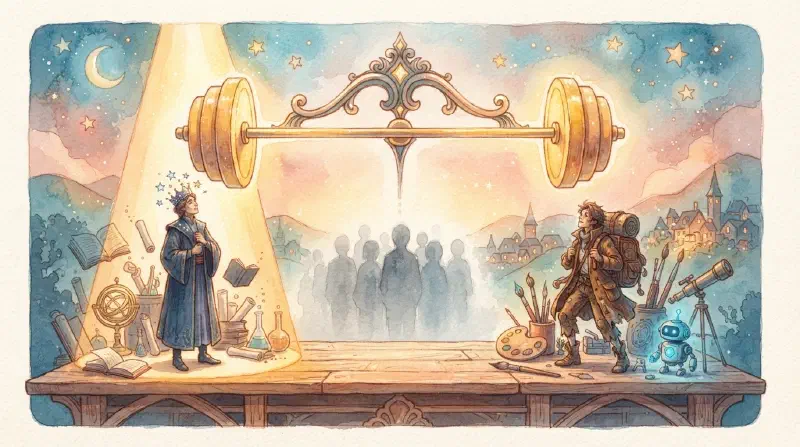
The two ends of the barbell:
- The top 1% deep specialist: ordinary writing ability is easily commoditized by AI—anyone with a large model can produce “pretty good” copy. But if you are the best 1% in a field, AI becomes a supercharger for you instead.
- The high-agency generalist: not necessarily world-class in any single domain, but characterized by “spot a problem → learn proactively → find tools → use AI → assemble resources → ship it.” One person can do part of what used to take a team of 5–10. Rogier is his own example—he uses Claude Code to build his own work tools rather than buying off-the-shelf software.
What’s genuinely at risk is the middle layer: people whose work is highly standardized and whose expertise has not become distinctly differentiated. Routine information organization, ordinary copywriting, basic analysis, basic code, standardized research—these are precisely where generative AI delivers the largest efficiency gains.
More interesting still is Li’s pushback against the popular narrative. The host cites a widely repeated claim: “The Industrial Revolution automated physical labor; the AI revolution will automate intellectual labor.” She doesn’t fully agree:
The Industrial Revolution did not simply automate “labor.” It raised labor efficiency, expanded the scale of production, and at the same time transformed labor markets and the forms labor takes. And physical labor itself contains a great deal of intelligence.
So “will AI replace my job” may be the wrong question. A better one: which skills will AI turn from scarce capabilities into ordinary ones? Once you work that out, you know which end of the barbell to move toward.
5. Education and the Next Generation: Socrates Was History’s Best Prompt Engineer#
Across these interviews, Li speaks about education with particular feeling—she is an educator herself, and her children are school-aged.
On children using AI, she identifies two extremes to guard against:
- Over-dependence: endless short-video scrolling and passively absorbing feeds erodes agency bit by bit. “The intrinsic motivation to learn and the ability to think independently cannot be taken away by any person or any machine. If AI is misused to erode a child’s agency, the next generation’s brains will not develop fully.”
- Blanket bans: prohibiting students from touching AI out of fear of cheating is equally misguided. She recalls wanting to master the spatial structure of organic chemistry molecules as an undergraduate, but teaching-assistant hours were short and always conflicted with her schedule—“If I’d had an AI learning assistant then, I could have asked repeatedly about the exact points where I got stuck. As long as there is a genuine desire to learn, AI is an extraordinarily powerful aid, and we should not deny students the chance to have it.”
On the ability to ask questions, she offers the line that traveled furthest of all:
Who was the greatest “prompt engineer” in human history? Socrates. His signature method of questioning is, at its core, layered and relentless probing—following the thread down to the essence of a thing. That way of thinking can absolutely be taught to children.

What worries her most, in fact, is frontline teachers and parents. When ChatGPT launched in 2022, she immediately emailed her child’s elementary school principal and offered to come in and talk to teachers and students—“Almost no one among Silicon Valley investors or trillion-dollar tech giants thought first about the teachers at their local schools, and yet this is precisely what matters most.” She returns to it repeatedly:
To protect the next generation, we must see teachers. Only by supporting teachers and parents can we truly guide young people to use AI well.
6. Governance and the “God Complex”: A Few Companies Should Not Decide for Everyone#
In the Bloomberg interview, Li criticizes Silicon Valley’s elite mindset more directly than usual. The host frames it as a “god complex,” and she runs with it:
The picture of future life should not be defined unilaterally by one company or one group of investors. All of society should participate and imagine it together. There’s a major problem with the current discourse around AI: ordinary people can only passively accept the outcomes technology delivers, with no way to participate in the design and planning beforehand.
She mentions a baseline principle from her AI policy advice to world leaders: “Science, not politics.” In the Huberman conversation she offers a concrete governance approach: the AI industry can learn from how automobiles and biotech matured—establish industry ethics codes, teach AI ethics in universities, and have authoritative bodies akin to the FDA draw safety red lines for high-risk applications like medicine. “We cannot let a handful of tech companies decide for all of society. The logic of chasing market returns must never take precedence over social ethics and public culture.”
She also voices concern about polarization in public discourse: some people are busy spreading doom, others are busy claiming technology can do anything. “Both are too extreme. We need to return to an objective, neutral perspective and let society as a whole take the initiative in shaping the future.” This is also why she founded Stanford HAI, the Institute for Human-Centered AI.
7. Five Takeaways for the Rest of Us#
Putting the four interviews together, I distilled five conclusions that ordinary people can actually use:
- Treat AI as a magnifier, not a stand-in. Let it amplify your expertise and your expression rather than doing your work for you—what gets replaced was never “the person” but “undifferentiated work.”
- Move toward one end of the barbell. Either go deep enough to be top 1% in a domain, or become a high-agency generalist who can say “give me a problem and I’ll solve it with AI.” The standardized middle is the dangerous place.
- Practicing questions is practicing thought. Socratic layered questioning is the highest-return self-training available in this era.
- Don’t overestimate the short term; don’t underestimate the long term. Spatial intelligence “won’t take 50 years, but will certainly take more than one”—plan your learning at that tempo, without either panic or complacency.
- Be rational and cautious about technology. Opportunity and dislocation arrive together; neither doom nor utopia is worth subscribing to.
References#
- QbitAI, “Fei-Fei Li’s latest interview: how could AI replace people?” (Chinese translation of the Huberman Lab interview) — https://www.qbitai.com/2026/08/474140.html
- Full English transcript of the Huberman Lab interview — https://singjupost.com/transcript-of-dr-fei-fei-li-interview-on-huberman-lab/
- DeepTech / Zhihu, “After launching Atlas, Fei-Fei Li’s latest interview: how do you predict a world that was never photographed?” (Chinese summary of the a16z Show) — https://zhuanlan.zhihu.com/p/2080642659710939733
- Data Application Lab, “AI godmother Fei-Fei Li: in 10 years only two kinds of people will have jobs” (summary of the Silicon Valley Girl interview) — https://www.dataapplab.com/only-two-kinds-of-people-will-have-jobs-in-10-years/
- Bloomberg video interview (2026-08) — official Bloomberg Business channel